Freemasonry & Mormonism: The Masonic Origins of the LDS Church (w/ Andrew Soncrant)
Freemasonry & Mormonism: The Masonic Origins of the LDS Church (w/ Andrew Soncrant)

[VIDEO] The Book of Mormon and Anti-Freemasonry Part 1 - Dan Vogel
https://www.youtube.com/watch?v=1QwDsJCLeqw
[VIDEO] The Book of Mormon and Anti-Freemasonry Part 2 - Dan Vogel

PLEASE SUPPORT ME
https://www.patreon.com/VincentBruno
Christian Science founder Mary Baker Eddy donated money to Masons and her husband spoke favorable of them
Does Christian Science have a connection to Freemasonry?
February 8, 2021
In answering this question, some background information is useful. Freemasonry is a fraternal order found in many countries, its membership consisting only of men. It is organized into several “bodies,” such as the Blue Lodge, Scottish Rite, York Rite, Royal Arch Masons, and Shriners.
Other organizations are associated with Freemasonry, including the Eastern Star, which admits both men and women, and the Order of DeMolay, which admits young men between the ages of 12 and 21. Rainbow Girls and Job’s Daughters admit young women between 10 and 20.
Initiates into Masonic bodies are given a series of “degrees,” consisting of rituals and allegorical plays symbolizing the moral and spiritual teachings of Masonry. In the United States, atheists are not accepted as members, and a member must have passed through the three degrees of the Blue Lodge (Entered Apprentice, Fellow Craft, and Master Mason) before being permitted to join any of the other Masonic bodies.
Some of Freemasonry’s symbolism derives from accounts and legends of King Solomon’s temple, and the work and tools of stone masons. Actual stone masons are referred to as “operative Masons,” with Freemasons known as “speculative Masons.” The core principles of Freemasonry are Brotherly Love, Relief, and Truth. Masons are enjoined to care for fellow members, as well as widows of deceased members. The order also engages in much charitable work.1
Mary Baker Eddy’s first husband, George Washington Glover, was an active Freemason in Charleston, South Carolina. Because of her exposure to the values of Freemasonry through him, and because of the care his brother Masons showed her after his untimely death in 1844, Eddy had a lifelong respect and appreciation for the Masonic Order. On page 19 of her autobiography, Retrospection and Introspection, she wrote:
My husband was a freemason, being a member in Saint Andrew’s Lodge, Number 10, and of Union Chapter, Number 3, of Royal Arch masons. He was highly esteemed and sincerely lamented by a large circle of friends and acquaintances, whose kindness and sympathy helped to support me in this terrible bereavement. A month later I returned to New Hampshire, where, at the end of four months, my babe was born.
Colonel Glover’s tender devotion to his young bride was remarked by all observers. With his parting breath he gave pathetic directions to his brother masons about accompanying her on her sad journey to the North. Here it is but justice to record, they performed their obligations most faithfully.2
Eddy’s third husband, Asa Gilbert Eddy, remarked on this appreciation in a September 15, 1877, letter to George Prescott, who had studied Christian Science with Eddy that February:
Mrs Eddy has had long experience with the Free-masons and is highly in favor of the Order and I think of joining them the first opportunity. Had you not better join them before locating in practice, Candidates are required to join where they have lived within the jurisdiction of the Lodge six months and within the state one year.
I think if the people of your place thought you had gone west and did not know what part of it you might do well to start a practice at Fair Haven Conn. my brother is there and is a Free-mason and if you were a member of that fraternity my brother and all of the Brotherhood would feel interested in you.3
In 1883 Eddy established a monthly publication, The Christian Science Journal, and in 1898 a weekly magazine, the Christian Science Sentinel. During her lifetime there were favorable mentions of Freemasonry and of her respect for it in these magazines. For example, the August 14, 1909, Sentinel quoted a Masonic publication, the New England Craftsman:
Mrs. Mary Baker Eddy, the Founder of the Christian Science church, has made a generous contribution of five hundred dollars to the Massachusetts Masonic Home [the equivalent of $14,307 in 2020]. We have before found pleasure in noting Mrs. Eddy’s favorable opinion of freemasonry, and her generous action speaks louder than words in testimony of the sincerity of her belief in its value. We hope her example may stimulate others of the opposite sex who have the means to do likewise.4
As the Christian Science movement grew, questions arose from time to time as to the appropriateness of its members being active in organizations other than those directly connected to Christian Science, including Freemasonry. For instance, on January 24, 1885, C. F. Morrill, a Christian Scientist in Chicago, wrote to Eddy and asked, “Is proper for a Christian Scientist to belong to a Free Mason Lodge. If a member should he withdraw.”5 While a reply from Eddy is not extant, in due time she gave guidance in the Manual of The Mother Church, in the form of a By-Law she sent to the Christian Science Board of Directors on May 2, 1904, titled “Church Organizations Ample.”6 It was published in the 41st edition of the Manual: “Members of the Mother Church shall not be made members of Clubs or organizations, the Free Masons excepted, which exclude either sex or are not named in the Manual of the Mother Church. God separates the tares and wheat to garner the latter in His storehouse.”7
Eventually Eddy decided to remove mention of specific organizations in that By-Law. And she included a statement that Mother Church members should “not unite with organizations which impede their progress in Christian Science,” as well as pointing out to members that “within the wide channels of The Mother Church” they had a “dutiful and sufficient occupation.”8
In the end, Eddy left it up to individual members to decide if an organization’s missions and goals would interfere with their “dutiful and sufficient” occupation as members of the Church of Christ, Scientist. Along these lines, Judge Clifford P. Smith, Manager of the Committee on Publication office in Boston, commented in a letter to the New Age magazine, regarding content in its February 1925 issue:
In the same issue there was an answer to a question which quoted a former By-law of Mrs. Eddy’s church, The First Church of Christ, Scientist, in Boston, which expressly excepted Freemasonry from a rule against members of this church joining other organizations. As this By-law was afterward amended, it is worded in general terms, without any mention of Freemasonry. As the By-law in question is now worded, it leaves each member of this church to decide for himself about joining any particular organization. It is quite true, however, that Mrs. Eddy regarded Masonry favorably.9

PLEASE SUPPORT ME
https://www.patreon.com/VincentBruno
PDF Available Here: https://drive.google.com/file/d/1mEfTWIOQXtc8s40LPkO9dOwibddQvs1y/view?usp=sharing
According to this article, The Book of Mormon was influenced by the Noahide Laws.
Title The Noachide Laws
Publication Type Journal Article
Year of Publication 2003
Authors Foley, Claire
Journal Studia Antiqua
Volume 3
Issue 2
Pagination 19-49
Keywords Laws; Legal

Read Fritz Springmeier's other book on Freemasonry and Jehovah's Witnesses, "The Watchtower and the Masons"
https://drive.google.com/file/d/1XTzMoESd-TYZnvaIhf1v_55XUST8Pzqx/view?usp=sharing
PLEASE SUPPORT ME
https://www.patreon.com/VincentBruno
In the Spring of 2002 the LDS Church completed its reconstruction of the Nauvoo Temple in Illinois. It was originally built in the 1840's but was destroyed after the Mormons abandoned the town. Due to the publicity and photos regarding this new temple many people have asked about the symbols on the building.

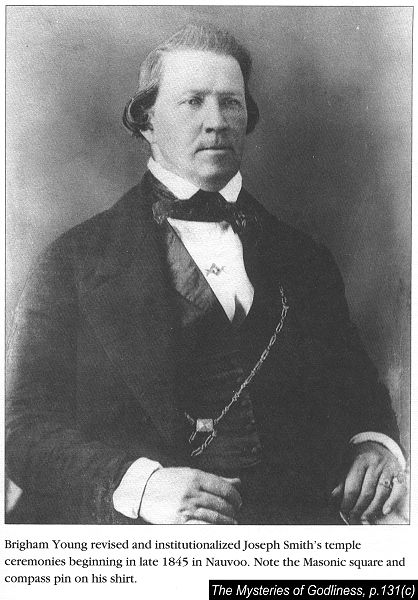
To understand the symbols one must first know something of Joseph Smith's involvement with Freemasonry. Joseph's brother, Hyrum, had been a Mason since the 1820's. Many other members of the LDS church, like Brigham Young, were Masons before they joined Mormonism. LDS historian Reed Durham observed:
"By 1840, John Cook Bennett, a former active leader in Masonry had arrived in Commerce [Nauvoo] and rapidly exerted his persuasive leadership in all facets of the Church, including Mormon Masonry. ... Joseph and Sidney [Rigdon] were inducted into formal Masonry...on the same day..." ("Is There No Help for the Widow's Son?" by Dr. Reed C. Durham, Jr., as printed in Joseph Smith and Masonry: No Help for the Widow's Son, Martin Pub. Co., Nauvoo, Ill., 1980, p. 17.)
Reed Durham further commented:
"I have attempted thus far to demonstrate that Masonic influences upon Joseph in the early Church history, preceding his formal membership in Masonry, were significant....In fact, I believe that there are few significant developments in the Church, that occurred after March 15, 1842, which did not have some Masonic interdependence." (Joseph Smith and Masonry: No Help for the Widow's Son, p.17)
The History of the Church records Smith's entrance into the Masonic lodge in 1842:
"Tuesday, 15.—I officiated as grand chaplain at the installation of the Nauvoo Lodge of Free Masons, at the Grove near the Temple. Grand Master Jonas, of Columbus, being present, a large number of people assembled on the occasion. The day was exceedingly fine; all things were done in order, and universal satisfaction was manifested. In the evening I received the first degree in Free Masonry in the Nauvoo Lodge, assembled in my general business office." (History of the Church, by Joseph Smith, Deseret Book, 1978, Vol.4, Ch.32, p.550-1)
The next day Smith recorded:
"Wednesday, March 16.—I was with the Masonic Lodge and rose to the sublime degree." (History of the Church, Vol.4, Ch.32, p.552)
The Mormon involvement in Freemasonry reached its heights during the early 1840's in Nauvoo. In the Encyclopedia of Mormonism we read:
"The introduction of Freemasonry in NAUVOO had both political and religious implications....Eventually nearly 1,500 LDS men became associated with Illinois Freemasonry, including many members of the Church's governing priesthood bodies—this at a time when the total number of non-LDS Masons in Illinois lodges barely reached 150." (Encyclopedia of Mormonism, vol.2, p.527)
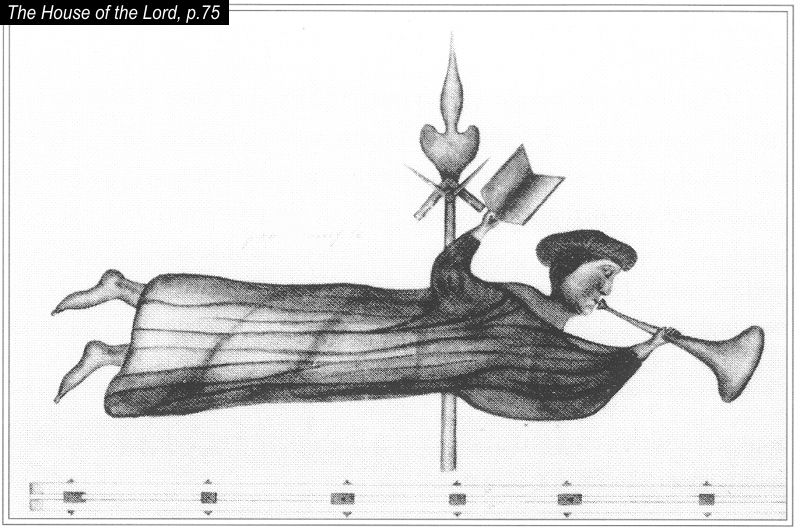
The Salt Lake Tribune (May 4, 2002, p.C3) printed a picture of the original Nauvoo temple weather vane, which shows the Masonic symbol of the compass and square above the angel. Reporter Peggy Stack wrote:
"Every detail of the historic Nauvoo Temple was reconstructed [in the new Nauvoo temple] meticulously with one exception: the flying angel weather vane that graced the top of the 19th century Mormon edifice.
"In its place is the gold-leafed Angel Moroni, first used on the Salt Lake Temple,...
"Some speculate that the horizontal angel, with its compass and square, may be too closely associated with Masonic rituals for modern Mormons." (Salt Lake Tribune, May 4, 2002, p.C3)

Reed Durham observed:
"There is absolutely no question in my mind that the Mormon ceremony which came to be known as the Endowment, introduced by Joseph Smith to Mormon Masons initially, just a little over one month after he became a Mason, had an immediate inspiration from Masonry....
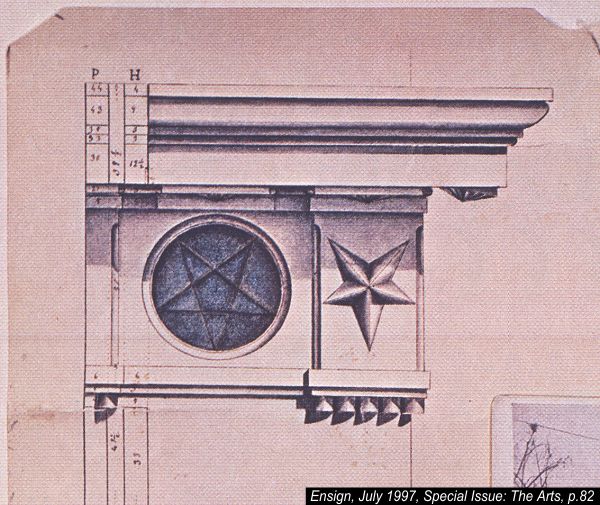
[Architect's drawing of the stars for the Nauvoo Temple.]

"It is also obvious that the Nauvoo Temple architecture was in part, at least Masonically influenced. Indeed, it appears that there was an intentional attempt to utilize Masonic symbols and motifs. The sun stones, and the moon and star stones, were examples. An additional example was the angel used on the weather vane on the top of the Temple. [Above the angel] is a beautiful compass and square, in the typical Masonic fashion." (Joseph Smith and Masonry: No Help for the Widow's Son, p.18)

Additional details of the Nauvoo temple symbols and pictures of the building are in the Deseret News 2001-2002 Church Almanac (see pp.120-141). On page 135 of the Almanac is a photograph of one of the original sunstones that were placed at the top of the columns around the outside of the temple. A photo of a sunstone is also in Fawn Brodie's book, No Man Knows My History, p.298(b).

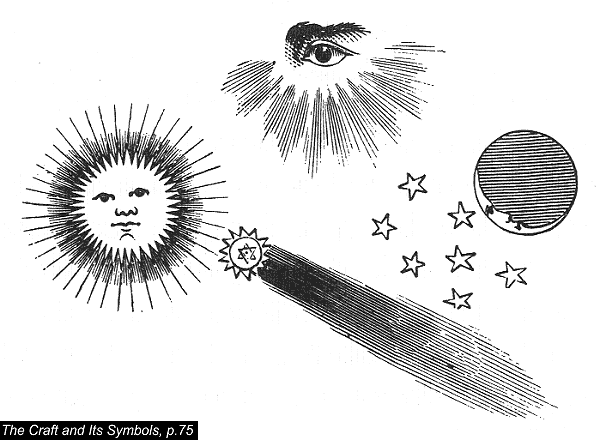
The Nauvoo sunstone, with its human face, is similar to the Masonic depictions of the sun. Below is an illustration from the Masonic book, The Craft and Its Symbols, p.75:

Masonic symbols have been pictured and discussed in a number of books. Albert Pike, in his book, Morals and Dogma of the Ancient and Accepted Scottish Rite of Freemasonry, discusses the various Masonic symbols and their meaning.
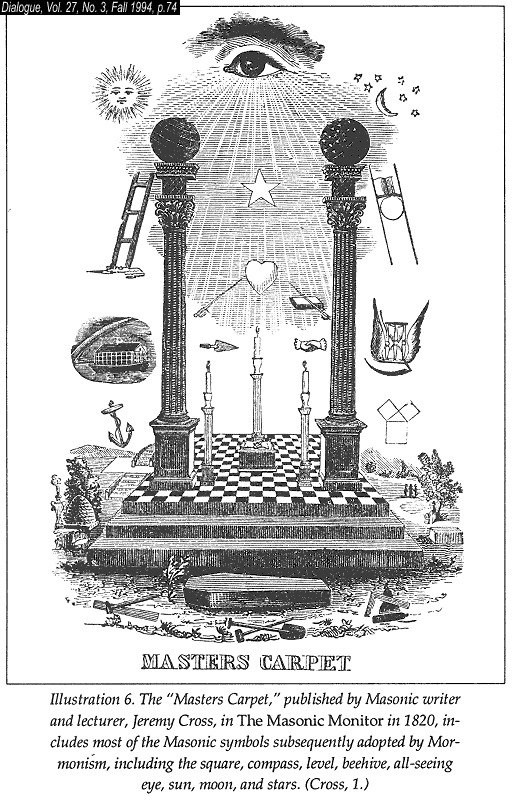
In the book The Craft and Its Symbols: Opening the Door to Masonic Symbolism, by Allen E. Roberts, p.11, is a drawing of the Masonic apron presented to President George Washington by Lafayette The symbols on the apron, which were later used by the Mormons, include a beehive, all-seeing eye, compass and square, and the sun, moon and stars.

The Masonic Monitor, in 1820, had an illustration of the symbols of Freemasonry. This drawing is very similar to Washington's apron.

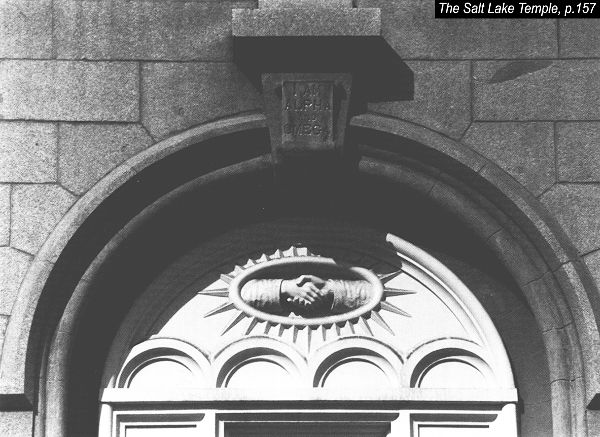
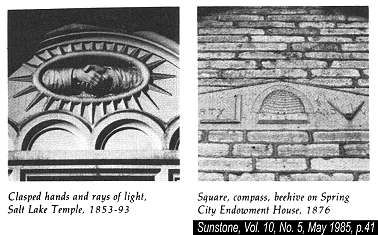
Many Masonic symbols (the sun, moon, stars, all-seeing eye, beehive, hand grip, and the beehive) were also placed on the Salt Lake Temple.


One of the more familiar symbols of Mormonism is the beehive. Examples of pioneer use of the hive can be seen on Brigham Young's home (known as the Beehive House) in Salt Lake City.


[Beehive House with Eagle Gate next to it.]
The beehive is also displayed on the doorknobs of the Salt Lake temple.

[One of the brass doorknobs in the
Salt Lake Temple displaying the beehive.]
However, most people are not aware that the beehive was a symbol of Masonry years before Joseph Smith started his church. Masonic historian Allen E. Roberts explains:
"The Bee Hive, Masonically, is an emblem of Industry....When and why the hive of the bee entered Freemasonry as a symbol no one knows....In the book, The Early Masonic Catechisms, the bee in Masonry is mentioned as early as 1724..." (The Craft and Its Symbols, by Allen E. Roberts, Macoy Pub., 1974, p.73)
While many people are aware of the symbols used on the Salt Lake temple, they were also used on other LDS buildings in Utah (see "Where Are All The All-Seeing Eyes?", Sunstone Magazine, vol.10, no.5, May 1985).


LDS researcher Michael Homer discussed the Mormon use of Masonic symbols:
"Even after the turn of the century and the abandonment of polygamy, the same comparison [to Masonry] was made. The First Presidency stated in a message on October 15, 1911, that '[b]ecause of their Masonic characters, the ceremonies of the temple are sacred and not for the public.'
"Mormon use of Masonic symbols has also been publicly acknowledged. Mormons were hardly discreet in their depictions of symbols long associated with Freemasonry...including the square, the compass, the sun, moon, and stars, the beehive, the all-seeing eye, ritualistic hand grips, two interlaced triangles forming a six-pointed star...and a number of other Masonic symbols on endowment houses, temples, cooperatives, grave markers, tabernacles, church meetinghouses, newspaper mastheads, hotels, residences, money, logos, and seals." ("Similarity of Priesthood in Masonry": The Relationship between Freemasonry and Mormonism, by Michael W. Homer, Dialogue: A Journal of Mormon Thought, vol.27, no.3, Fall 1994, p.73)

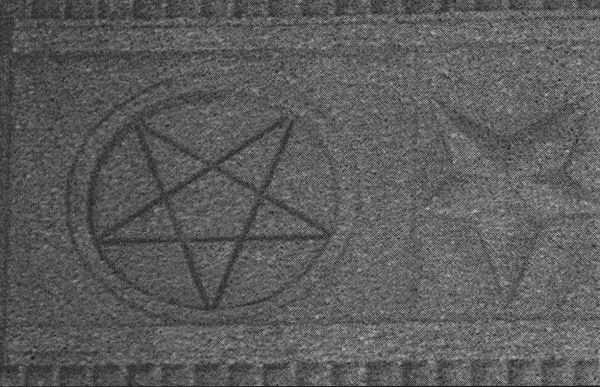
In addition to these symbols, the LDS Church continues to use the up-side-down, five pointed star. The newly completed Nauvoo Temple has numerous windows using it. For pictures see (off-site links):
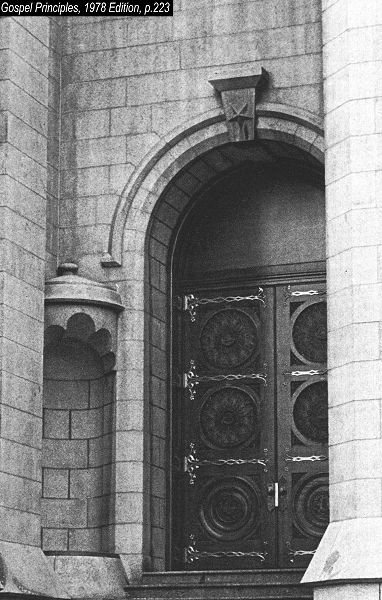
The inverted star was also used on the Salt Lake temple above the front doors,

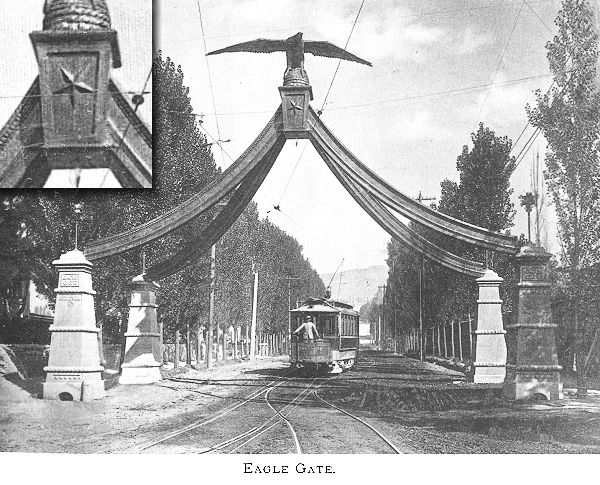
above the upper arched windows on the north and south sides, on the Eagle Gate monument (over State Street and South Temple in Salt Lake City),

on the planter boxes in front of the statue of Christ in the Salt Lake Visitors Center,

and on the front entrance, upper left-hand corner, of the LDS Historical Museum (west of temple square).

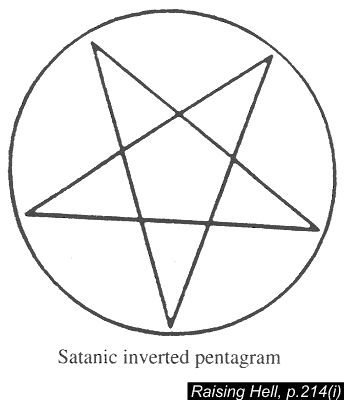
While the upside-down star is used in Masonry, it is also used by Satanists.

Also, on the LDS temple undergarment (worn daily by LDS faithful) are embroidered the compass and square. This would look like small zigzag stitching to form a "V" on the left breast and a "L" on the right breast of the garment. There is also a small stitched line at the bellybutton and the right knee. These are on both the men's and the women's underwear. The garment is to be worn daily to remind the Mormon of the covenants made in the temple.
Since the LDS Church rejects the use of the cross as a religious symbol, one is left to wonder why they would adopt symbols used by the Masons and Satanists?
When trying to explain the similarities between Mormonism and Masonry, one LDS author wrote:
"Masons who visit the Temple Block in Salt Lake City are impressed by what they call the Masonic emblems displayed on the outside of the Mormon Temple.
"Yes, the 'Masonic emblems' are displayed on the walls of the Temple—the sun, moon and stars, 'Holiness to the Lord,' the two right hands clasped in fellowship, the All-seeing eye, Alpha and Omega, and the beehive. Masonic writers tell us that the Mormon Temple ritual and their own are slightly similar in some respects.
"Without any apologies we frankly admit that there may be some truth in these statements." (Mormonism and Masonry, Introduction, by E. Cecil McGavin, Bookcraft, 1956)
Later in the same book, Mr. McGavin stated:
"In the diary of Benjamin F. Johnson, an intimate friend and associate of Joseph Smith, it is recorded that 'Joseph told me that Freemasonry was the apostate endowment, as sectarian religion was the apostate religion.' Elder Heber C. Kimball, who had been a Mason for many years, related that after Joseph Smith became a Mason, he explained to his brethren that Masonry had been taken from the priesthood." (Mormonism and Masonry, p.199)
The problem with Mr. McGavin's position is that neither the Masonic or Mormon rituals can be shown to date to King Solomon's temple. In fact, most historians place the beginning of Freemasonry in the 1700's. LDS author Michael Homer wrote:
"Prior to 1860 most Masonic writers accepted the legends of Freemasonry with claimed that it originated in antiquity. Although these claims were challenged by most anti-Masonic writers in the United States,...most Masonic writers refused to discount these claims until 'a school of English investigators' began to evaluate lodge minutes, ancient rituals, and municipal records. Eventually this movement...debunked the notion that the rituals practiced in Speculative Freemasonry originated before the sixteenth century. Gould and others argued that the best evidence indicated that Operative Freemasonry originated with trade guilds in the Middle Ages and that the development of Speculative Freemasonry, with ceremonies and rituals similar to those practiced today, began in the seventeenth century....the rituals of Freemasonry have never been static, but have evolved both in time and place. For example, only post-1760 rituals included separate obligations for degrees in conjunction with signs, penalties, tokens, and words, the form found in most subsequent rituals and the same format followed in the Mormon temple endowment." ("Similarity of Priesthood in Masonry," Dialogue: A Journal of Mormon Thought, vol.27, no.3, Fall 1994, pp.103-104)
Since Freemasonry dates to the 1700's and Joseph Smith was a Mason before he introduced the LDS temple rituals and built the Nauvoo temple, one is forced to conclude that the similarities between the two groups are due to Smith borrowing elements from Masonry.
For more information see our page: Captain Morgan and the Masonic Influence in Mormonism.
Also see these off-site links:
See My Brother Blog But Harmless As Doves 7th Day Adventism, Anti-Masonry & Nazism www.ButHarmlessAsDoves.blogspot.com PLEASE SUPP...